



The 9/21 EMA Crossover: We Tested 6 Years of Nifty Data to See If It Actually Works
Every trader has heard of the 9/21 EMA crossover. It’s one of the most talked-about strategies in technical analysis across the NSE and BSE. But does it actually make money, or is it just another overhyped myth?
To find out, we backtested six years of Nifty 15-minute data—1,373 trades in total—to see if this famous indicator holds up in the real world. The results might surprise you.
What Exactly Is the 9/21 EMA Crossover?
Let’s start with the basics. An EMA (Exponential Moving Average) is a moving average that gives more weight to recent prices, making it more responsive to price changes than a simple moving average.
When a faster EMA crosses a slower EMA, traders use it to identify potential changes in trend or momentum. For this backtest, we used the 9 EMA as the fast line and the 21 EMA as the slow line.
- Crosses ABOVE: Bullish signal (potential buy).
- Crosses BELOW: Bearish signal (potential sell).
The concept is simple: when the 9 EMA crosses above the 21 EMA, momentum is shifting upward. When it crosses below, momentum is shifting downward. But does that simple signal actually translate into profitable trades in the Nifty 50 universe?
The Test: 6 Years, 1,373 Trades
We ran the numbers on six years of Nifty 15-minute data. In total, the strategy generated 1,373 trades.
The win rate? Just 48.5%.
Less than half the trades were winners. On the surface, that looks like a losing strategy. Most retail and institutional traders would assume that a win rate below 50% means you’re going to lose money. But here’s where it gets interesting.
The Surprising Result: Profitable Despite a Sub-50% Win Rate
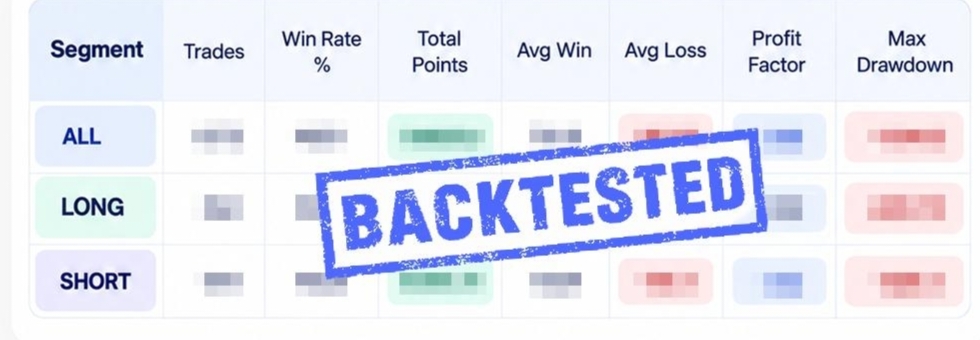
Despite winning less than half the trades, the strategy was profitable. It generated a total of +10,856 points, with a Profit Factor of 1.30.
How is that possible? The reason becomes clearer when you look at the winners versus the losers:
- Average Winner: 70 points
- Average Loser: 51 points
That’s roughly a 1.38x Win-to-Loss Ratio. The strategy could be profitable despite a sub-50% win rate because the average winner was larger than the average loser. In simple terms: the strategy didn’t win more often, it just won bigger.
The Long vs. Short Breakdown
Did it only work on one side? Not really. The data shows the strategy performed consistently on both long and short trades in the index:
- Long trades: +5,495 points (Win rate: 50.58%)
- Short trades: +5,361 points (Win rate: 46.39%)
Both sides contributed almost equally to the overall profit. This tells us that the 9/21 EMA crossover isn't just a one-way strategy suited only for a raging bull market. It can capture momentum in both directions.
However, it’s worth noting that the long side had a slightly better win rate, while the short side had a slightly better profit factor (1.32 vs 1.29) and a smaller maximum drawdown.
The Real Lesson: Your Exit Matters More Than Your Entry
Here is where the backtest revealed something crucial. The exit strategy mattered far more than you might expect:
- Day-end exits: +36,980 points
- Reverse-crossover exits: -26,125 points
Same EMA concept. Same entry signals. But very different outcomes depending on how you exited the trade.
This is the biggest takeaway from the entire experiment. Most traders obsess over the perfect entry. They spend hours staring at charts, waiting for that perfect crossover. But the data shows that entry is only half the strategy. Your exit can completely change the result.
If you had held every trade until the end of the day, the strategy was massively profitable. If you had exited on the reverse crossover signal, the strategy lost money. The entry was identical. The outcome was opposite.
The Takeaway
The 9/21 EMA crossover worked in this backtest. But the bigger lesson isn't about the indicator itself. It's about the importance of a complete trading plan.
A strategy isn't just an entry signal. It's an entry, an exit, and a risk management plan. Without all three, even a "winning" strategy can lose money.
The data doesn’t lie. The 9/21 EMA crossover can be profitable—but only if you know how to exit.