



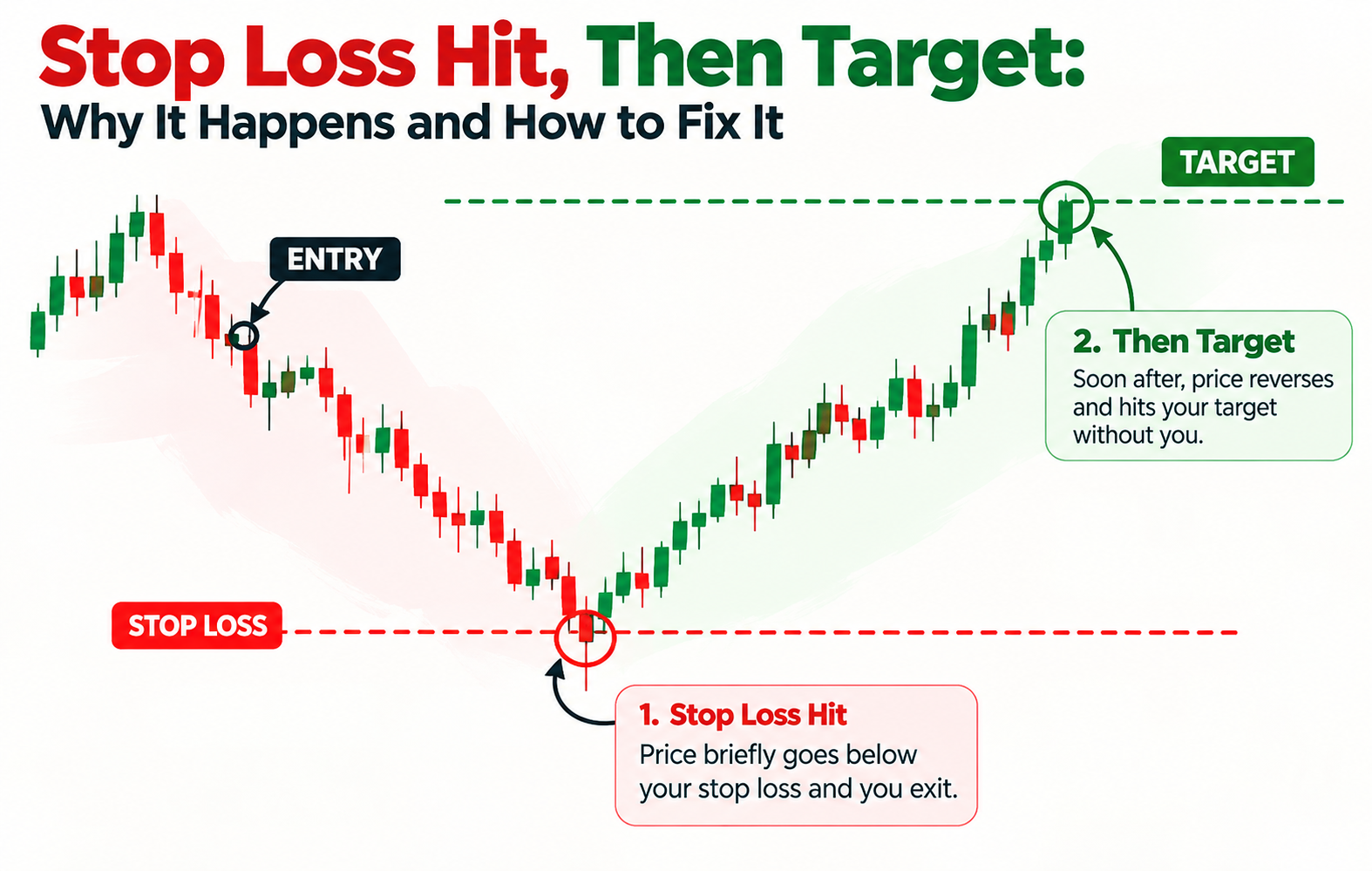
We've all been there. You buy the breakout. Price dips. Your stop loss gets hit. You're out of the trade. And then, almost like magic, the price reverses and runs straight to your target without you.
It feels personal. It feels like the market hunted your stop. But the truth is more mechanical than malicious. Here is why this happens, and how to fix it.
The Anatomy of a Stop Hunt
Let's trace the exact sequence. Price breaks above a previous resistance high. You buy the breakout, placing your stop loss just a fraction of a point below the breakout level because it feels safe and keeps your risk tight. Then, price pulls back slightly. Your stop gets triggered, and your position is closed.
Here is what is actually happening beneath the surface on the order books: your stop loss was sitting right where thousands of other retail traders placed theirs. That dense cluster of stop orders forms a localized liquidity pool. When price dips to sweep that zone, the resulting cascade of triggered sells provides the exact fuel institutional buyers need to fill large buy orders. Those sell orders get quietly absorbed by larger institutional players, and once the liquidity has been thoroughly swept, price reclaims the level and continues its march higher.
This is what professional traders call a liquidity sweep. Not every stop hunt is deliberate manipulation by big players, but when price crosses a level and sharply reverses, understanding this underlying mechanics is essential for survival in the Indian markets.
Why a Pullback Is Not a Failure
Here is the most critical distinction every technical analyst must master: a failed breakout and a healthy retest look almost identical in the heat of the moment.
- Failed Breakout: Price breaks the resistance level, but immediately falls back into the consolidation range and stays there. The momentum has died, and the breakout has failed.
- Retest + Continuation: Price breaks the level, pulls back to test the old resistance (which now acts as support), holds firm, and then continues higher. The breakout is completely valid.
The difference lies entirely in price action at the level. If the level holds as support, the bullish move continues. If the price breaks back down decisively, the setup is invalidated. A standard pullback is simply not the same thing as a breakout failure.
The Three Checks Before You Buy
Before you execute any breakout trade on the Sensex or Nifty 50, run through these three mandatory checks:
- 1. Candle Close: Did the candle actually close above the resistance level? A long wick that spikes above and closes back inside the range is a rejection, not a breakout. Wait for confirmation.
- 2. Retest: Did the price come back to the breakout level and successfully hold it? If it holds, the breakout is confirmed. If it slices straight back down, stay on the sidelines.
- 3. Stop Loss Placement: Where is the technical level that would genuinely prove your thesis wrong? If placing your stop loss at that logical technical level risks more capital than your plan allows, don't move your stop closer—simply reduce your position size to keep your total risk fixed.
Confirmation is never a 100% guarantee in the stock market, but applying these three checks will dramatically improve your odds of success.
Stop Blaming the Market, Start Studying the Setup
When your stop loss gets hit, resist the urge to blame market makers. Instead, review your execution, tighten your technical placement, and let probability work in your favor.e market operators and instead review your execution. Trading is a game of probabilities, not certainties—mastering the mechanics of liquidity will keep you in the game long-term.e operator games or market riggedness. Instead, take a screenshot of the chart. Save it, and review it at the end of the trading session with three probing questions:
- Was my entry too early?
- Was my stop loss placed too tight?
- Was the overarching chart setup flawed from the beginning?
This is how consistent profitability is built. You don't improve by blindly moving your stop loss further away into no-man's-land; you improve by deeply understanding why the stop got triggered in the first place. Maintain a detailed trading journal, track your entry prices, key levels, and subsequent price reactions. Over time, recurring patterns will become obvious.
The Takeaway
Stop losses get hit—it is an inevitable, unavoidable part of trading. But if your stops are getting clipped repeatedly at the exact same spot, it is rarely just bad luck; it is a setup problem. Understand liquidity sweeps, always wait for the candle close, confirm the retest, and place your stop loss at a technical level that genuinely invalidates your setup. Most importantly, review every loss as a lesson rather than a failure. The market isn't hunting you down; it is simply doing what it always does.